AI infrastructure debt has a measurement problem.
Unmeasured, it prices at private credit. Measured, it prices at infrastructure. Machina is the methodology that closes the gap — 350 basis points, or $35 million per $1 billion of debt.
A $20 trillion market constraint, hiding as a measurement gap.
No metrologically traceable basis
GPU degradation has no measurement standard. There is enough physics to know what to measure — electromigration, thermal cycling, transient stress — but not enough empirical data to price it. The first generation of large-scale H100 fleets has not yet retired. There is no degradation curve to anchor institutional capital.
No covenant-grade attestation
Solvency II Article 132, NAIC asset valuation, and Bermuda BSCR all converge on the same requirement: independently verifiable measurement. None exists for AI infrastructure. Trustee platforms, rating agencies, and methodology teams have nothing to ingest. The compute tranche of every AI deal is therefore funded as private credit or hyperscaler equity.
No insurance market
Without measurement, residual value risk cannot be insured. Without an insurance product, the asset cannot be admitted into the general accounts where $20 trillion of institutional capital is willing to sit. The bottleneck is not appetite. It is attestation.
avoidable spread cost per $1bn of unmeasured AI infrastructure debt, per year
spread compression between unmeasured (+500 bps) and measured (+150 bps) infrastructure debt
NVIDIA data centre revenue, FY2026 alone — cumulative shipments cross $1T by FY2028
10-year NPV cost-of-capital benefit on a typical $1.5bn sovereign AI compute tranche
Source: Machina white paper, From Unmeasured to Investment-Grade. April 2026. Read the full methodology →
Built on Sentinel · NPL-traceable
Machina is the measurement-backed financial layer.
The first metrologically grounded basis for pricing AI infrastructure risk.
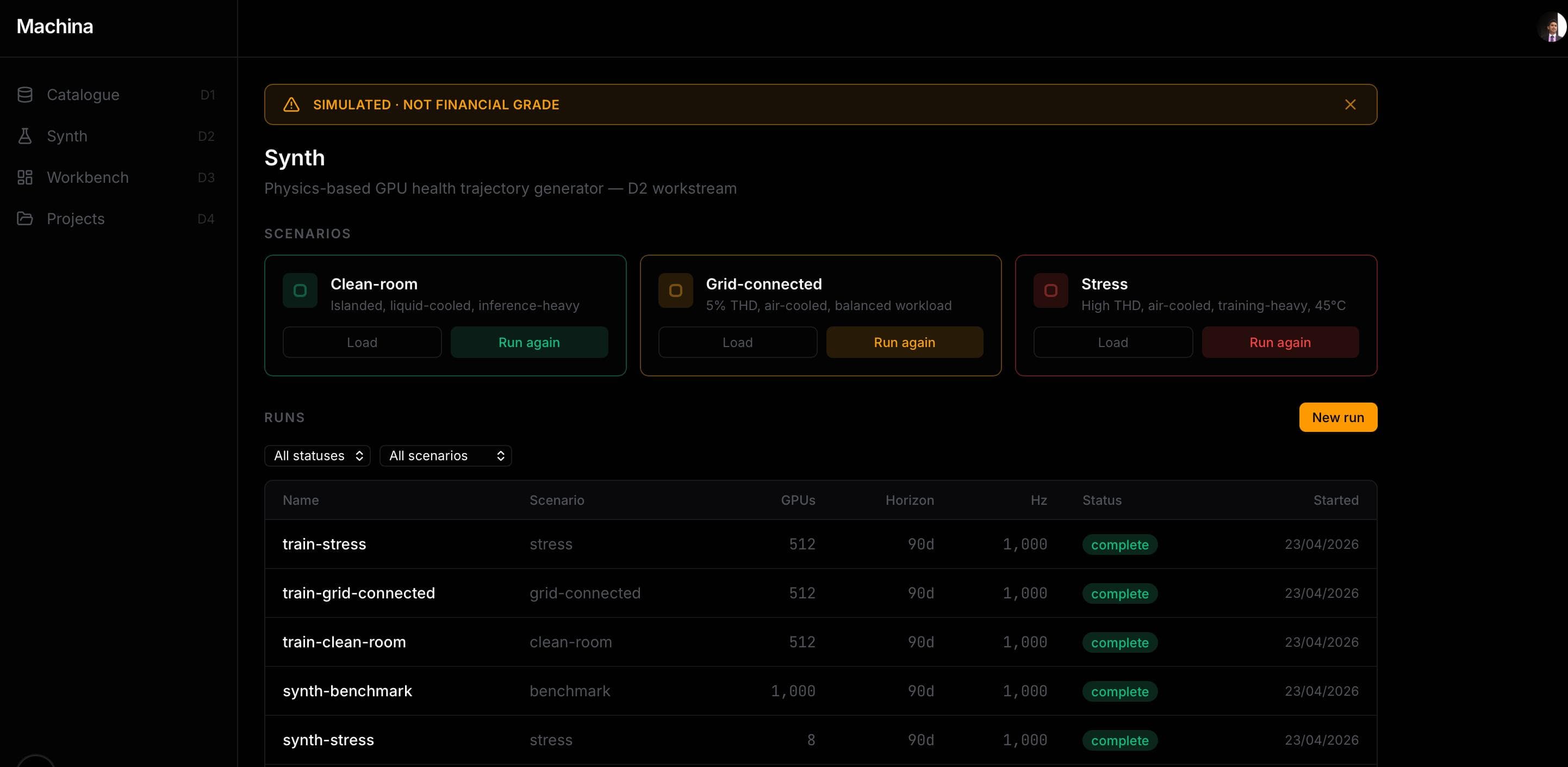
Data foundation
Curated dataset foundation
Public failure datasets — Llama 3, LANL HPC, Backblaze, Google Borg, NREL — catalogued with provenance, licence discipline, and quality scores. Synthetic data is watermarked at every layer. The catalogue is the foundation; everything downstream is auditable back to it.

Financial translation
The model canvas: spread compression made concrete
On a $1.5 billion compute tranche, Machina is a $300–450 million net-present-value cost-of-capital instrument. Spread compression of 350 basis points, residual value insurance at 50–75 bps, and a covenant feed schema that drops directly into trustee platforms and rating-agency MRM pipelines. The canvas summarises the financial wedge in one page — the white paper sets out the methodology behind it.
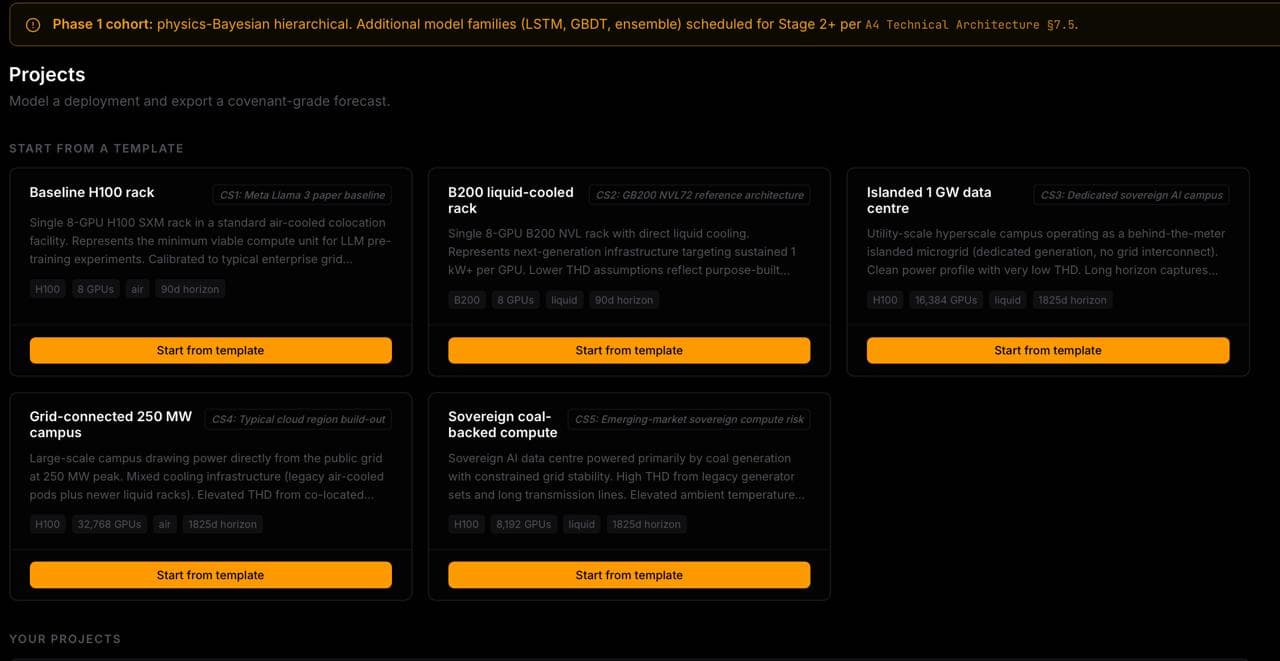
Covenant-grade forecasts
Covenant-grade forecasts
Bayesian risk models with priors grounded in degradation-physics literature, calibrated for rating-agency model risk review. Three primary outputs: per-GPU degradation trajectory, RUL distribution, fleet Kaplan-Meier survival. Exports as JSON or PDF covenant feed, schema-compatible with Sentinel's post-Golden-Rack attestation stream.
Built on real institutional infrastructure.
NPL Partnership
Metrological traceability via the UK National Physical Laboratory — recognised across 105 nations through CIPM MRA.
GB2630720 · 7 in prosecution
Granted patent on real-time energy tracking and cryptographic provenance, plus seven additional applications under review.
$536bn balance sheet partner
A major life insurer has been publicly discussed as a counterparty for residual value insurance on attested GPU fleets, at 50–75 basis points on insured fleet value.
$46bn JETP capital
BlackRock / GFANZ / JETP channel — 675 GFANZ members, multilateral first-loss precedent at 3.00 percent on sovereign AI tranches.
See the methodology. Then see it in action.
The white paper sets out the measurement gap, the insurance market consequence, and the methodology that closes both. The demo shows the platform built on top.
Or email us directly — machina@empati.ai